

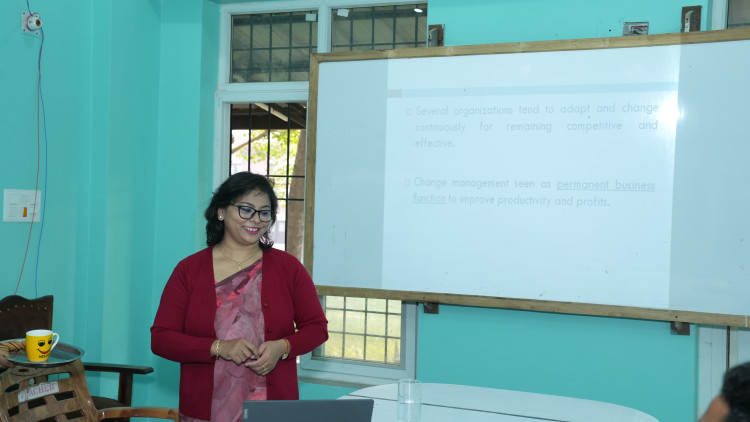
The MBA program is a two-year, four-semester course with 70 credit hours under the affiliation of Purbanchal University (PU). The program is designed to support individuals in accelerating their personal and professional development. It aims to prepare competent entrepreneurs, dynamic business leaders, efficient managers, and responsible human resources for the nation through both academic and extracurricular activities.
Eligibility for admission in MBA Program
Students seeking admission to MBA Program must have completed Bachelor level in any discipline having minimum 45% or 2.00 CGPA from the university recognized by Purbanchal University, Nepal.
Admission Intake: Spring Session (January/February) 31 seats.
Master of Business Administration
Objective
The MBA program specifically aims to prepare professional managers for the business and non-business sectors, develop entrepreneurs capable of evaluating risks and taking challenges in the emerging global business environment and inculcate knowledge, skill, and attitude in students so that they become scientifically approached, result oriented, and socially responsive management professionals.
Non Credit Course for Non Management Background Students
Extensive Classes for 15 Days:
NC-1: Qualitative Skills for Business Studies
NC-2: Accounting Knowledge for Managers
Semester Structure
Semester I (17 credit hours): Foundation courses including Quantitative Skills, Managerial Communications, Economics, Legal Environment, Organizational Behaviour, Marketing, and Financial Accounting.
Semester II (20 credit hours): Core management courses including Management Accounting, Macro Economics, Financial Management, Operations Management, Human Resource Management, and Business Research.
Semester III (15 credit hours): Advanced topics including Management Information System, Organization Change, Entrepreneurship, and Specialization courses.
Semester IV (18 credit hours): Strategic courses including Strategic Management, International Business, advanced specializations, and Internship/Thesis.
Specialization Areas
Finance (14 credit hours): Financial Theory, Capital Structure Management, Security Analysis, Financial Derivatives, and International Financial Management.
Marketing (14 credit hours): Consumer Behavior, Marketing Research, Retail Business, Sales Management, and Advertising Management.
Human Resource Management (14 credit hours): HR Planning, Industrial Relations, Compensation Management, and Strategic HRM.
International Business (14 credit hours): International Business Environment, Export-Import Management, and Multinational Strategies.
Production and Supply Chain Management (14 credit hours): Supply Chain Design, Production Planning, and Facility Management.
Core Required Courses for all majors:
Semester I
| Subject Code | Subjects | Credit Hours |
|---|---|---|
| CO 511 | Marketing for Managers | 3 |
| FA 512 | Communication for Managers | 3 |
| CO 513 | Accounting for Managers - I | 3 |
| FA 514 | Legal Framework of Business | 2 |
| FA 515 | Decision Sciences | 3 |
| EL 515 / EL 517 | Elective - I | 2 |
| Total Credit Hours | 16 |
Semester II
| Subject Code | Subjects | Credit Hours |
|---|---|---|
| CO 521 | Accounting for Managers - II | 3 |
| CO 522 | Human Resource Management & Organizational Behavior | 3 |
| FA 523 | Economics for Managers | 3 |
| CO 524 | Financial Management | 3 |
| CO 525 | Operations Management | 3 |
| SE 526 | Seminar - I | 2 |
| EL 527 / EL 528 | Elective - II | 2 |
| Total Credit Hours | 19 |
Semester III
| Subject Code | Subjects | Credit Hours |
|---|---|---|
| CO 531 | Entrepreneurship and Social Enterprises | 2 |
| CO 532 | Research Methodology and Thesis Proposal | 3 |
| CO 533 | Information Technology Management | 3 |
| SE 534 | Seminar - II | 2 |
| Specialization - I | 2 | |
| Specialization - II | 2 | |
| EL 535 / EL 536 | Elective - III | 2 |
| Total Credit Hours | 16 |
Semester IV
| Subject Code | Subjects | Credit Hours |
|---|---|---|
| CA 541 | International Business | 3 |
| CA 542 | Strategic Management | 3 |
| SE 544 | Seminar - III | 2 |
| Specialization - III | 2 | |
| Specialization - IV | 2 | |
| TH 545 | Thesis | 6 |
| Total Credit Hours | 18 |
An MBA opens doors to leadership, management, and strategic roles across many industries. Graduates can work in both national and international organizations, startups, NGOs, banks, IT companies, manufacturing industries, and government sectors.
Major Industries for MBA Graduates
Popular MBA Career Opportunities
An MBA helps students develop:
Employers highly value communication, leadership, and analytical skills in MBA graduates
MBA graduates can find opportunities in:
In Nepal, sectors like IT, banking, fintech, healthcare, and digital business are growing rapidly for MBA professionals.